Showing posts with label links. Show all posts

Monday, April 21, 2014

The artist's brain: they are both right!


A new neuroscience study surfaced, focused on what makes artists' brains different from non-artists' ones!

The scientists used MRI to find out, put plainly, what areas of the brain got bigger in people who could draw from observation, and in people who went through artistic training, compared to the average.

Their findings?
"Observational drawing ability relates to changes in structures pertaining to fine motor control and procedural memory, and that artistic training in addition is associated with enhancement of structures pertaining to visual imagery."
The changes also seem to be in proportion to artistic skill.

What is noteworthy is that the three structures that visibly develop more gray matter in us artists are in the right hemisphere, the left hemisphere, and the right side of the cerebellum. There is no "artistic side" neatly located in the "creative" right hemisphere, as the pernicious myth propagated by Betty Edwards claims. Instead, unsurprisingly, drawing is a motor skill supported by visualization.


The science journalists, of course, are blowing this a bit out of proportion. I have encountered the claims that it means that artistic talent may be innate. Even the long pop-science article published by BBC states that:
"The research, published in NeuroImage, suggests that an artist's talent could be innate."
The research suggests little of the sort, yet. It is more than equally likely that the changes in the brain are the result of training than preexisting, because some the same areas are enlarged in people who learn fine motor control, like musicians.

The only way it could demonstrate any support for innate talent would be by finding that children who had preexisting enhanced brain areas ended up in art schools. But that kind of study was not done - and children aren't born able to draw, we all have to start from zero. At most, such preexisting enhanced processor would enable you to learn to draw a little faster. But you still have to learn.

Instead, it is now known that the brain is malleable and adaptable. What this enhancement of brain areas means is that with enough exercise, you can learn to draw. With enough exercise, you can learn visual imagination. There is no magic, just hard work.

Here is the BBC article: http://www.bbc.com/news/science-environment-26925271
Here is the original abstract: http://www.sciencedirect.com/science/article/pii/S1053811914002237

Friday, April 4, 2014

Dougal Dixon's Greenworld surfaces in an interview


This is a page from Greenworld, by Dougal Dixon known for his speculative evolution books like the seminal After Man: A Zoology of the Future. Unfortunately, the two-volume work detailing the prolonged human impact on an alien planet had been published only in Japan:


I hope there is going to be an English version. I haven't even heard of this until I stumbled upon an interview with Dixon by Darren Neish which I recommend to read. Dixon and Neish discuss the creation of After Man and its spin-offs, the complications of getting it published, the new Greenworld book, and assorted tasty paleontology. There are illustrations aplenty, including Dixon's sketches and even maquettes.


 Incidentally, Dixon called Man After Man a "disaster of a project" in that interview. This makes me glad: the thing is as abysmal as After Man is delightful, and this dismissal demonstrates his true integrity. He didn't give detail on that, but you can catch hints of him being co-opted into a spin-off which went into ludicrous deviations he was not happy with.

Go read the interview.

Sunday, February 9, 2014

Africa


In 1903, the British government had offered the revitalized Zionist movement a strip of land in Uganda.

The Ottoman empire held what is now Israel, Jordan and parts of Syria under its rule. They weren't in any hurry to let the Jews live there, and large parts of Europe, especially Russia, also didn't like the Jews much. By early 1900s, another wave of pogroms in Russia sent the Zionist Congress seeking an urgent escape way, and they did consider Africa as a very possible venue. Some considered it as refuge  until the return to the actual historical Land of Israel could be made; some thought that any place to live in peace would be better than living in hostile countries, historical ties or not; and some thought that temporary solutions often become permanent, and agreeing to go to Uganda would de facto void their claim to the Land of Israel. Nonetheless, the Zionist Congress went as far as sending a investigatory expedition there, which found that the climate was suitable but the land was wild, and the local Maasai warlike. In 1905, they decided to decline the Uganda solution.

This tiny piece of history is still remembered in Israeli politics, however.  Uganda is tossed around whenever someone gets accused of not caring about the historical ties of the Jewish nation to the Land of Israel, and putting the importance on a safe haven alone.

So you occasionally get little puns like this final project of design student Yoav Gati, fusing the Israeli paraphernalia with African motifs. Not that it would really happen if the Jews had settled on the Mau Escarpment in what is now Kenya: they insisted on carrying their old colors and symbols everywhere, and though the orange-green-yellow-blur-violet flag is quite decorative, they'd probably still fly the same blue-and-white one anywhere.
 

I find it highly ironic, though, that Yoav's takes on the African-Israeli currency actually look better than the real modern Israeli currency:


Saturday, April 14, 2012

Literalism surrealism

Sometimes, there's nothing like injecting a little literalism into your interpretation to make it surreal.


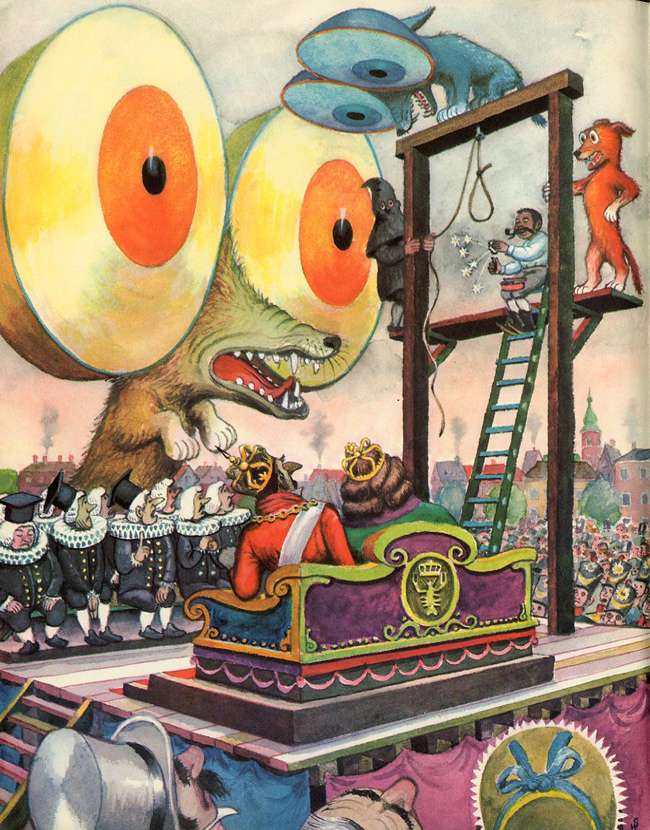
But with fairy tales, literalism is guaranteed to make your interpretation surreal, as Ursula Vernon discovered for herself.


I am sure this was not the way Andersen imagined it when he borrowed the three round-eyed dogs for his version of The Tinderbox... but then Heiri ("Heinrich") Strub comes along and interprets the "eyes as big as the Round Tower" literally and blows everyone's brain up:


Ah, literalism... I love you.


(via 50watts)

Thursday, March 22, 2012

Museum of Not Quite Forgotten Art Supplies

The "Museum of Forgotten Art Supplies" has been making rounds of the web, recently.


What I cannot understand about it is how many of these "forgotten" supplies are actually not forgotten.

Obsolete computers? Marginally fitting the "art supplies" label, but alright, no one is probably using 1984 Macs nowadays. Polaroid cameras and Letraset stickers? Made obsolete by digital stuff; all right.

But ellipse templates and French curves, forgotten? Not only do I have a set hanging next to my desk, but they are still manufactured and sold. Hardly forgotten! Drafting sets? I still have my father's drafting set which is older than I am, still with all tools, and I still use it on occasion. This particular set counts as "vintage" in our day, but I had seen plenty of new ones sold in an art-and-calligraphy store in San Francisco Chinatown, so hardly forgotten by everybody. Razor blades? Rollers? Rulers?..

The book section is even more puzzling. Designing with Type is still in print and not made less relevant by the digital tools. And if they think Andrew Loomis is obsolete or forgotten, they should check out conceptart.org where half the participants, me included, swear by the man's textbooks.

Then they have tape? I cannot work without tape!

It gets weirder when you see that there is a section for pens and pencils.

I am not sure what to think. Perhaps the creator of the museum believes that if any art supply or text is not about computers, it is forgotten. There was no history before 2000!

Still, if you like to ogle art supplies or be reminded about old books on art technique, go check them out.

Tuesday, November 8, 2011

Jon Schindehette writes about standing out

Art director Jon Schindehette wrote this about the current concept and fantasy art scene:

So often when I attend a convention and wade through hundreds of portfolios in a weekend, I am struck by the “sameness” of them all. So many folks have the same look, the same style, the same mark making techniques. It’s almost as if there is this fantasy/sci-fi Photoshop filter running around the internet. < . . . > At the end of a long and tiring con, do you think I remember the one guy that excelled at the predominate style? Maybe. But I can guarantee that I remember the folks that stood out from the crowd – the amazing gouache artist, the stellar water-color artist, the person that was doing something in Photoshop that I had never seen before. Nope, I didn’t really remember anyone that had applied the SFS Filter to their work. They just didn’t stand out.

It's true for any art scene from any age.  Many people copy, but few people dare to invent. For every Rembrandt or Vermeer, there are a thousand Dutch painters who were producing the same run-of-the mill stuff. It's just that we get to see everything that is in vogue today, but to see those Dutch run-of-the-mill products you have to go to third-tier museums that cannot afford Rembrandt. The same will eventually happen to the artists of our times.

The full article link:  http://theartorder.com/2011/08/26/differentiate-or-die/

Wednesday, October 26, 2011